
Independent Indian Railways information guide
PNR Prediction: Understand Your Confirmation Chances
Will your waiting-list ticket confirm? PNR prediction estimates that possibility using booking information and past patterns. It can help you plan, but a high percentage does not reserve a seat or change your ticket’s current status.
Check the latest passenger status first, then read any confirmation estimate alongside it. Indian Railways describes its prediction as indicative and warns that the actual result can differ.
This independent guide explains how to use those estimates. We do not currently provide a live prediction calculator. For the enquiry procedure, see our main PNR status guide.
Read these separately
Current status
Your reservation position now.
Confirmation estimate
A forecast of a future outcome. It cannot reserve a berth.
On this page
PNR Prediction vs Current Status
Current Status describes your reservation now. A forecast estimates a future outcome. Keeping the two separate helps you avoid treating a promising number as a confirmed ticket.
| Information | What it tells you |
|---|---|
| Current Status: WL 12 | The passenger is currently waitlisted. |
| Current Status: CNF | The reservation is confirmed. |
| Prediction: 80% | An estimated chance of the provider’s stated future outcome. |
| Charting Status | Whether the relevant chart has been prepared. |
A forecast may refer to a confirmed berth, reaching either CNF or RAC, one passenger, or everyone on the booking. Read the provider’s definition before comparing numbers.
How to Check PNR Prediction and Confirmation Chances
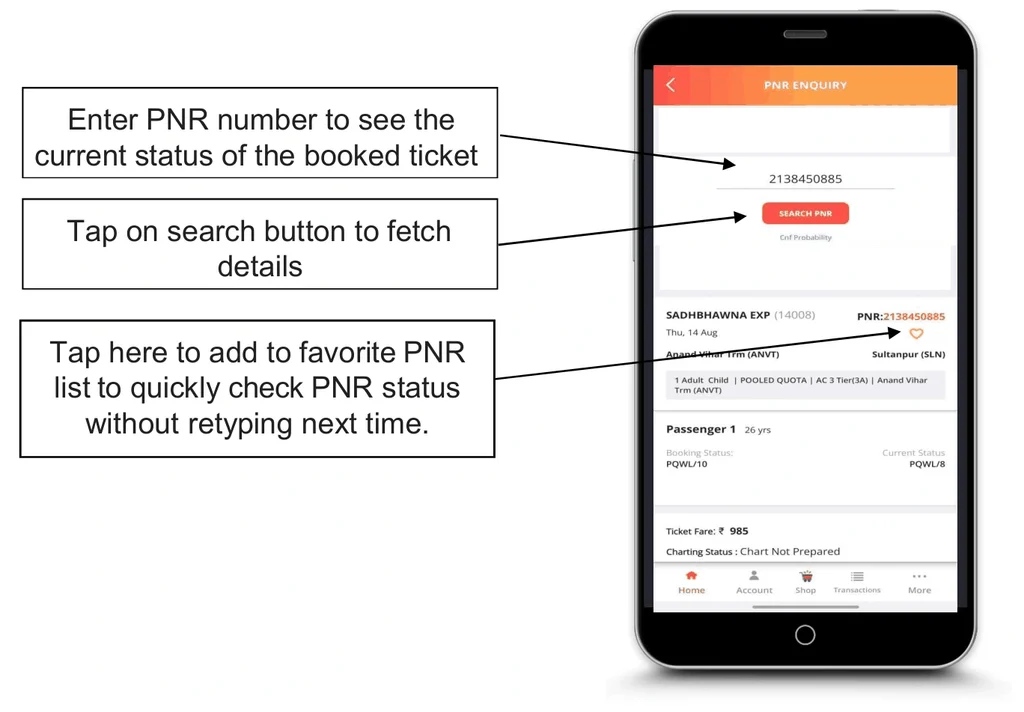
Start with the railway enquiry service for your current result. For probability information, use the relevant option in IRCTC or RailOne where it is available. The Rail Connect manual shows a “Cnf Probability” link on its PNR enquiry screen; app versions and supported journeys can differ.
- Find the 10-digit PNR on your ticket and open your booking or the app’s PNR enquiry section.
- Check the train, journey date, class and each passenger’s current position. Make sure you are looking at the intended booking.
- Open the confirmation-probability option if shown. Sign in if the service requests it.
- Read what the estimate measures, which passenger it covers and when the information was updated.
- Recheck the official reservation result before travelling, especially after chart preparation. Follow the actual status and applicable ticket rules.
What Does a Confirmation Percentage Mean?
Suppose an app gives a passenger an 80% chance of reaching CNF. It estimates that confirmation is more likely than non-confirmation, while still allowing for failure. It does not mean 80% of a berth is reserved or that the ticket is already confirmed.
In a well-calibrated model, about 80 out of 100 comparable cases assigned an 80% probability would reach the stated outcome over time. That is how to interpret a probability, not evidence that a particular app has achieved that result.
There is no universal percentage at which waiting becomes safe. Consider the cost of missing the journey. An exam, connection or essential appointment may justify a confirmed alternative even when the forecast looks encouraging.
How PNR Prediction Works
A prediction system looks for patterns in previous bookings and applies them to a current enquiry. Indian Railways documented a machine-learning confirmation tool in 2018, using historical waitlisted bookings and updating the estimate from the current position.
That announcement described General Quota coverage and holiday-rush patterns. It explains the earlier system; it should not be treated as a complete specification for every prediction service available today.
Details worth checking include:
- Current waiting position and category: GNWL, RLWL, PQWL and TQWL represent different lists. The same number on two lists is not enough to establish equal chances.
- Journey details: compare the same train, travel date, class and station pair. An outcome from another route or class is not a reliable benchmark for your booking.
- Cancellations and quota release: Railways explains that RAC and waiting-list positions update against cancellations and unused reservation quotas being released.
- Travel period and time remaining: holiday demand and the remaining opportunity for changes affect the context. Providers may account for these differently.
A forecast is only as useful as its data and method. A detailed-looking percentage should not be mistaken for direct access to every future cancellation.
How Accurate Is PNR Prediction?
Accuracy varies by service, the journeys evaluated and how success is defined. A model’s overall accuracy and your ticket’s confirmation percentage answer different questions.
In a release dated 7 May 2026, the Ministry of Railways reported that RailOne’s waitlist prediction accuracy had increased from 53% to 94%. This is an official reported system figure, not a 94% confirmation chance for every ticket. The release does not provide a full evaluation dataset, test period or quota-by-quota breakdown.
When a provider advertises high accuracy, check whether it counts RAC as success, includes uncertain predictions and evaluates forecasts made at comparable times before departure. A headline figure without those details is difficult to compare fairly.
Why Do Apps Show Different Chances?
One service might show 60% while another shows 85% for the same booking. Possible reasons include different models, historical samples, update times or definitions of a successful outcome.
For example, a service estimating CNF or RAC is answering a different question from one estimating a full confirmed berth. A whole-booking probability also differs from a passenger-specific estimate.
Do not average conflicting numbers or select the highest simply because it is reassuring. Check the latest official status, compare what each number measures, and use the uncertainty when deciding whether you need an alternative.
Why Has My Percentage Changed?
An estimate may change after the waiting list moves, as departure approaches or when the provider updates its information. It can also stay unchanged because the displayed value is rounded.
If WL 18 becomes WL 9, the queue position has improved. That movement does not guarantee the same pace will continue, and it does not tell you that exactly nine separate bookings were cancelled.
Refreshing a result does not improve your place. Check again when you need to make a travel decision rather than treating every small percentage change as a new reservation outcome.
What Should You Do With the Result?
Use this PNR prediction checklist to connect the estimate with a practical next step:
| What you see | Practical next step |
|---|---|
| High chance, still WL | Keep checking. Arrange a suitable backup if missing the trip would cause serious disruption. |
| Low chance, still WL | Look for confirmed availability on another train, date or suitable class. |
| Current Status: RAC | Plan for RAC accommodation; do not assume a full sleeping berth. |
| Current Status: CNF | Check the assigned coach and berth or seat when available. |
| Conflicting or missing forecasts | Rely on the latest reservation status and avoid treating uncertainty as a guarantee. |
For an e-ticket where every passenger remains waitlisted after chart preparation, IRCTC says the names are removed from the chart and those passengers must not board using that ticket. Mixed bookings need separate attention; one confirmed passenger does not give everyone a confirmed berth.
Before cancelling or buying a replacement, review the relevant fare and cancellation conditions. A prediction service cannot change railway allocation rules by displaying a higher score.
Frequently Asked Questions
Can a 90% or 99% prediction still fail?
Yes. An estimate below certainty allows for an unsuccessful outcome, and the model itself may also be wrong. Only the actual updated reservation status establishes whether you have reached CNF or RAC.
Which PNR prediction app is most accurate?
A fair ranking needs comparable, independently verified results across journeys and prediction times. Reported accuracy alone is not enough. Use official services for reservation status and assess any forecast’s method, coverage and limitations.
Does a low chance mean my ticket is cancelled?
No. A low estimate describes the provider’s outlook. Check Current Status separately for cancellation or other changes, and consider alternatives if your travel date is fixed.
Will RAC become a fully confirmed berth?
It may, but that is not guaranteed. RAC permits travel on a valid reservation without assuring a full sleeping berth. Check whether a forecast measures that upgrade or merely counts RAC as a successful result.
Does paying for a prediction improve confirmation chances?
Paying to view an estimate does not move your ticket up the railway waiting list. A paid service may offer additional information or a separate commercial benefit; read its terms before buying.
Can I estimate confirmation before booking?
Some services show probability information alongside waiting-list availability before a PNR is issued. Check the exact journey, class and quota. That estimate can change after booking and does not hold accommodation for you.
Plan With the Estimate, Travel on the Actual Status
PNR prediction can help you weigh your options, especially when the travel date is close. Read what the percentage measures, keep a suitable backup when the journey matters, and check every passenger’s latest status before leaving.
For a current reservation result, use the official Indian Railways enquiry. A forecast never replaces that result.
This is an independent information guide, not an Indian Railways or IRCTC service. Official guidance checked on 12 November 2026.
Explore more railway guides
Check PNR status · PNR status by SMS · Trains between stations
Independent guide. Not affiliated with Indian Railways or IRCTC.